

Saint Francis

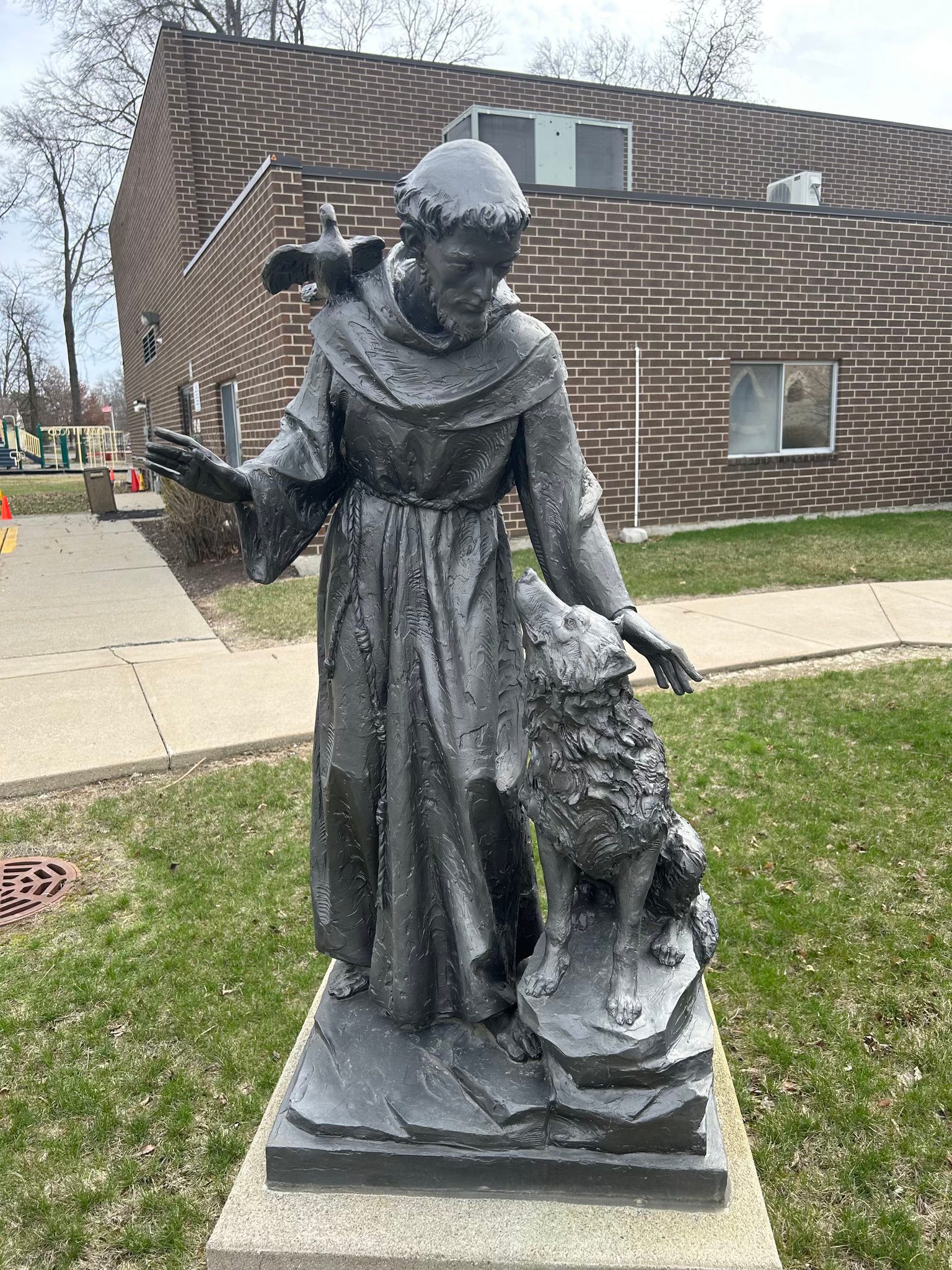
My son-in-law sent me this photo, a statue in a park outside church. He texted that my daughter wanted me to see it (she only keeps a flip phone, by design) and to tell me that it’s “Saint Francis and his Matsu.” I am delighted that she saw not just that of all the shapes of dogs there are, this dog is shaped more like Matsu than many other dog shapes, but more the way the two are engaged with each other. I am happy that even though my relationship with Matsu is most highly engaged when we are by ourselves, out in the woods having our dedicated conversations, that she saw the clear human-dog connection in this piece and thought “like Mom and Matsu.” She put in significant dog walk time with me as she was growing up and I forget sometimes that she knows perfectly the way that the dogs and I are close.
I am no theologian and am not even Catholic, but I’m going to look at this with my old art-school Art History 101 hat on, and my dog owner hat, too. There are versions of the story I won’t be aware of and deeper theologic themes I may not even scrape. But it’s public art and here for us to connect with from whatever we bring with us, so here we go!
This dog is actually the flock-eating, shepherd-killing Wolf of Gubbio, whom St. Francis formed a relationship with by going outside the town to meet him where he was and… they had a conversation! St. Francis didn’t subdue him, or wrestle him - this is not Samson and Lion, it is not Saint George and the Dragon. He chose to ask questions, and understand and engage with the Wolf. They had a conversation and made an agreement. Saint Francis asked the question, “Brother Wolf, what’s going on with you? Why are you doing this?” the Wolf explained that he was so hungry, and desperate and the wild game was harder to come by around the town, and even though there were also hunters among humans, they did not understand him as a fellow and tried to hurt and kill him right back.
Francis didn’t harm him, threaten him, or send him away to the mountains to never return. He asked him if he would consent to another way, and start a fresh relationship with the community: cooperate and be cared for by the people and end the cycle of violence and misunderstanding. Francis offered to facilitate this understanding between the Wolf and the people. The Wolf agreed and bound this pledge before God with Shake-a-Paw, walked freely into the city alongside Saint Francis, who explained the situation to the amazed people, and they agreed. The Wolf lived there among the people as a mascot of the town of Gubbio, and became their symbol of the miracle of Saint Francis and the power of God to inspire and maintain a peaceful agreement through understanding. When the Wolf died, he was buried there and the Church of Saint Francis of Peace was built over him.
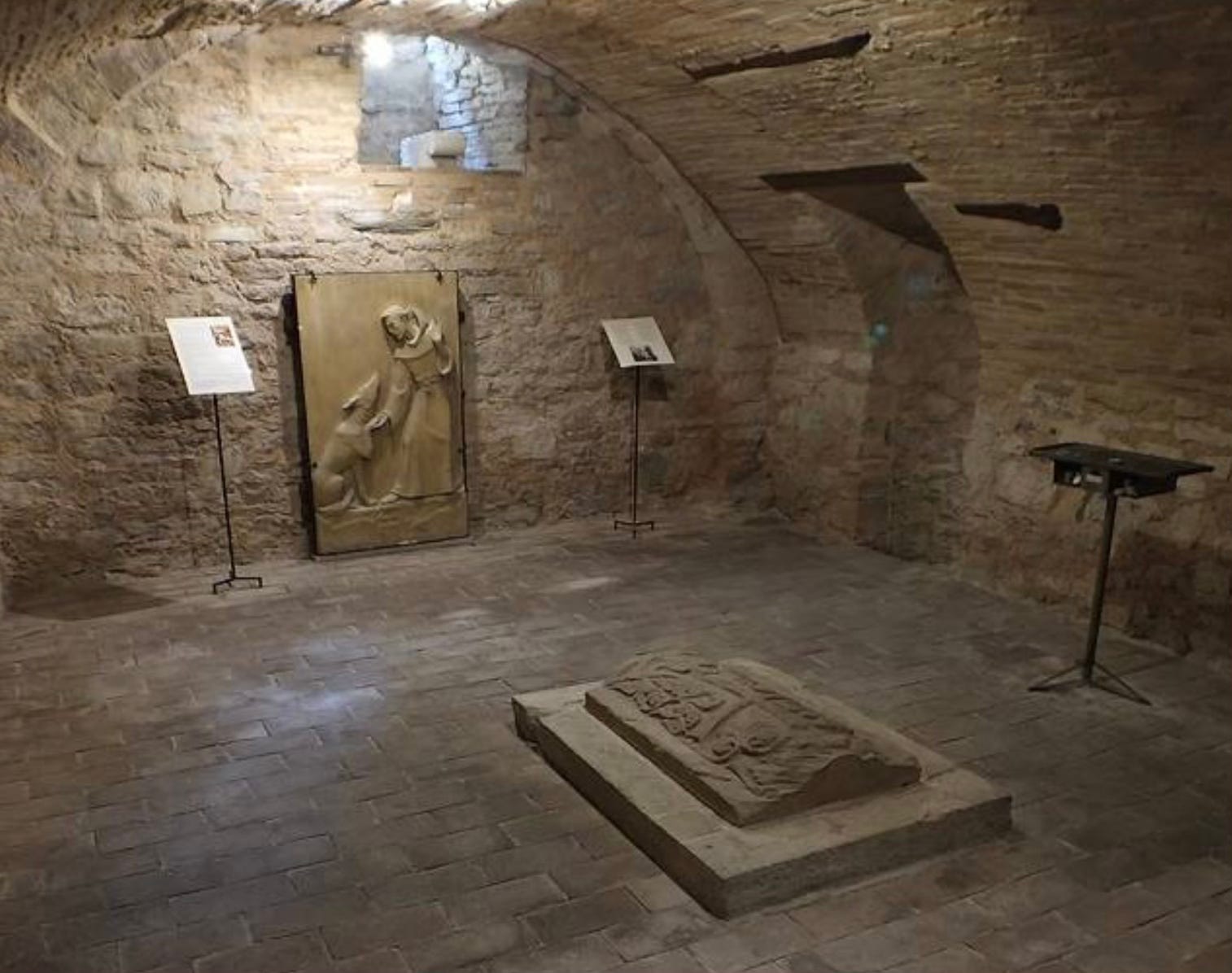
Most artwork of Saint Francis and the Wolf depict the wolf meekly putting its paw in his hand, as above, or its head in Francis’ lap. Usually they are facing each other. This statue is a different composition: Saint Francis is engaged with the Wolf, they are connecting with their heart and mind and conversation only, and they are side by side, facing out together. There’s no staff, there’s no leash, there’s no collar, no tools at all. St. Francis isn’t even touching the wolf. He has no treats. It’s pure relationship. He isn’t commanding, he isn’t coddling: they are outdoors together, free to choose anything and they choose each other. Saint Francis looks entirely interested in what the Wolf is ‘saying’ - not us the viewers, and not even the bird *just* landing on his shoulder breaks his engagement with the Wolf. (Francis’ dedication to the conversation is literally “unflappable!”) Saint Francis has time and attention for you, Brother Wolf. He is curious, he hears you, he gets it, and it matters to him what you have to say and finding a way to resolve everybody’s condition is important to him.
.
The Wolf’s ears are not back in supplication in this statue, they are up but not leaning forward in arousal or eagerness. They are the natural, relaxed ears of an up-eared canine. This Wolf is engaged, agreeing of his own volition, and importantly retains dignity. He is not reduced to groveling, slavish appeasement or the look of a distant and “dumb,” unknowable animal. The Wolf is even placed by the sculptor atop a stack of stones, he is elevated! These artistic decisions contribute to the quality of Saint Francis’ miracle - he did not belittle or reduce the Wolf, he created peace with a powerful sentient being in its own right, entirely hands off: with listening, offering a different way and gaining consent and agreement. This is excellent ethics and shows the enlightened mind and heart of Saint Francis.
Writing about a saint reminds me of a thought I have about my own babble as I fuss over my dogs. “You’re such a Good Dog! The Best Boy! The very Goodest Boy there is!” And I pet him the way he likes and he shines back at me, pleased but without human concepts like Good or Evil at all. What does Good mean to a dog? and Why am I so unthinkingly judgey about it in my sweet-talk? I even say, every time I leave the house, “Good bye! (Matsu/Juno) is in charge. Puppies-be-Good!” They always are, because we have lived over a decade together and built and communicated till we all agree and understand What We Do.
Our understanding, agreement, consent and congruity IS the Good. The Quality of our relationship is the Good, and what I announce as I rustle in my pocket to confirm that I do have the car keys before shutting the door behind me is more a benediction in honor of those qualities, that though I am leaving the house, those qualities remain strong. Or that in this moment right here as we tickle on the floor, “You are such a GOOD dog,” right now, I am experiencing the joy and appreciation of our alignment and I love that Good. We both do. It is a testament to our comfort and security in this relationship. What is Good to my dog is what feels safe, enjoyable and reliable and the choices and actions he favors to access those feelings are well-worn and trusted. We call it Good.
St Francis: "Seek first to understand, then to be understood." Lovely take on St Francis and the wolf.
Yes, the connection is so clear. I grew up next door to a nunnery and in front was a statue of St Francis with an outstretched palm. My sisters navigated the statue's height. I could, after a few years, sit comfortably in the palm of St Francis. It was appropriate that there were many animals next door, in our house, next to St Francis in Rockford, Illinois. As the youngest of 6 daughters, I felt at home in his palm. There were strays, gerbils, hamsters, cats, dogs, mice: whatever crossed our paths, we were honored with their lives. The statue was reminiscent of that time in my life. It's a beautiful statue above. Thank you.